Helm by ACS
Operational command built for Bitcoin mining
One live view of fleet, power, and pools, so your team spots drift before it becomes lost production. Built by the team that runs a 100,000 sq ft repair floor.
The demo is simulated. No account, and changes reset with your session.
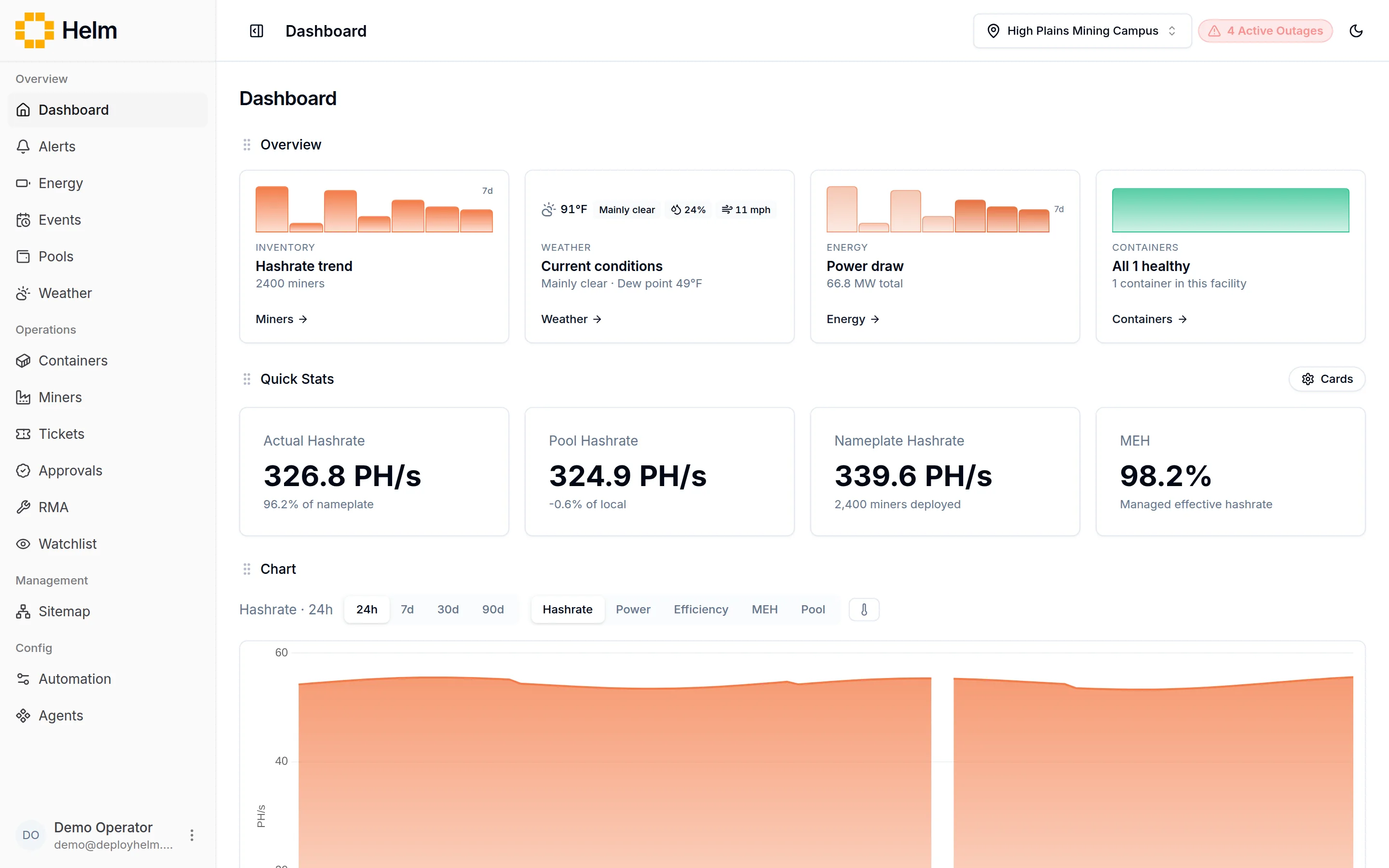
Captured from the Helm demo environment. Every number is simulated.
Lost production hides in the gaps between tools
Performance
Find drift before it compounds
A weak hashboard costs a little every hour. Helm surfaces underperforming units early, so a slow slide gets caught as a maintenance item, not a monthly write-down.
Execution
Coordinate the next move clearly
Alerts become owned work orders with context attached. Fewer ambiguous handoffs between shifts, sites, and the repair bench.
Power
Protect uptime when power gets tight
See what a curtailment call costs before you commit it, and make margin-aware decisions with power and production in the same view.
Monitor
Every miner, every site, one screen
Real-time telemetry on every unit: hashrate, temperature, fan speed, and error codes, rolled up by site and fleet. Sort by what is costing you the most and drill from the fleet to a single hashboard in a couple of clicks.
- Fleet and per-site hashrate against nameplate
- Thermal and fan outliers flagged before they cost hashrate
- Offline, degraded, and curtailed states kept separate
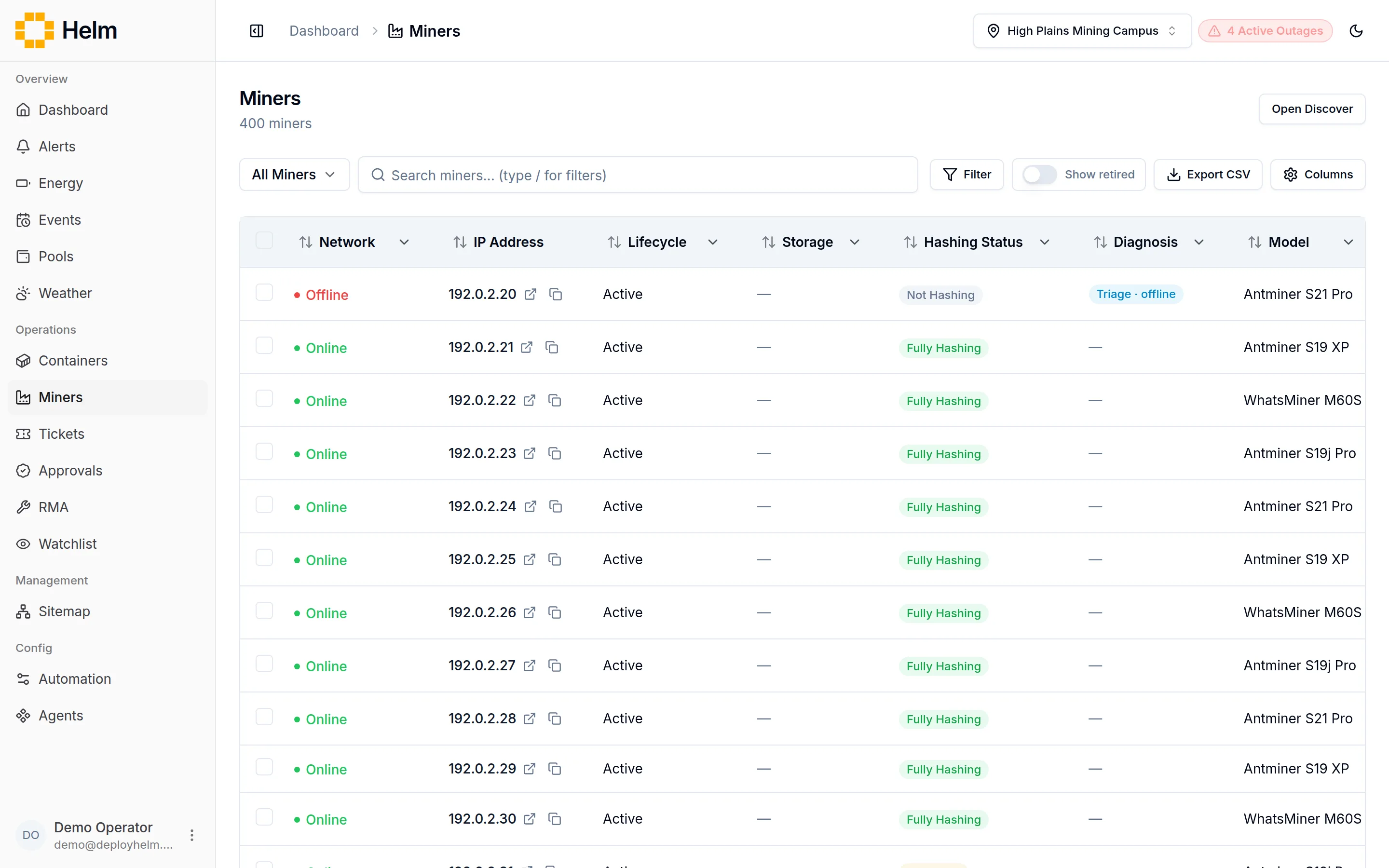
Captured from the Helm demo environment. Every number is simulated.
Alert → Dispatch
Alerts that turn into owned work
Helm cuts alert noise down to incidents with context, attributes the likely fault, and turns each one into a work order with the unit’s history attached. The technician on shift sees the same record the operations lead does.
- Fault attribution that separates hardware from infrastructure
- Work orders with owner, status, and unit history
- Infrastructure outage logs kept apart from hardware faults
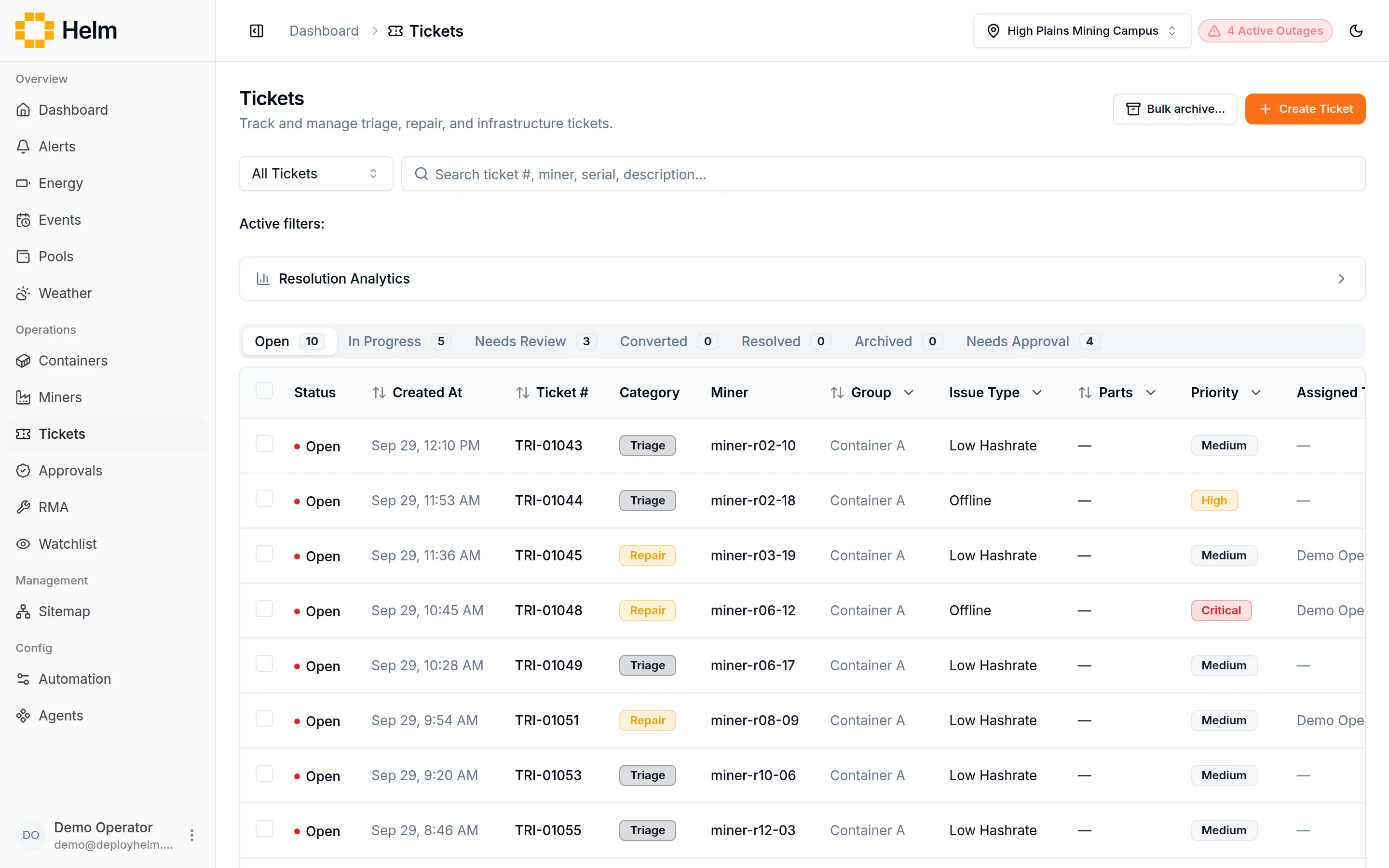
Captured from the Helm demo environment. Every number is simulated.
Orchestrate
Pool and power changes at fleet scale
Push a pool change, a power profile, or a firmware setting to a selection of miners in one action, with fallback routing and an audit trail. Model a curtailment call before you commit it.
- Fleet-wide pool changes with fallback routing
- Demand response with impact modeled first
- Site-specific playbooks and a change audit trail
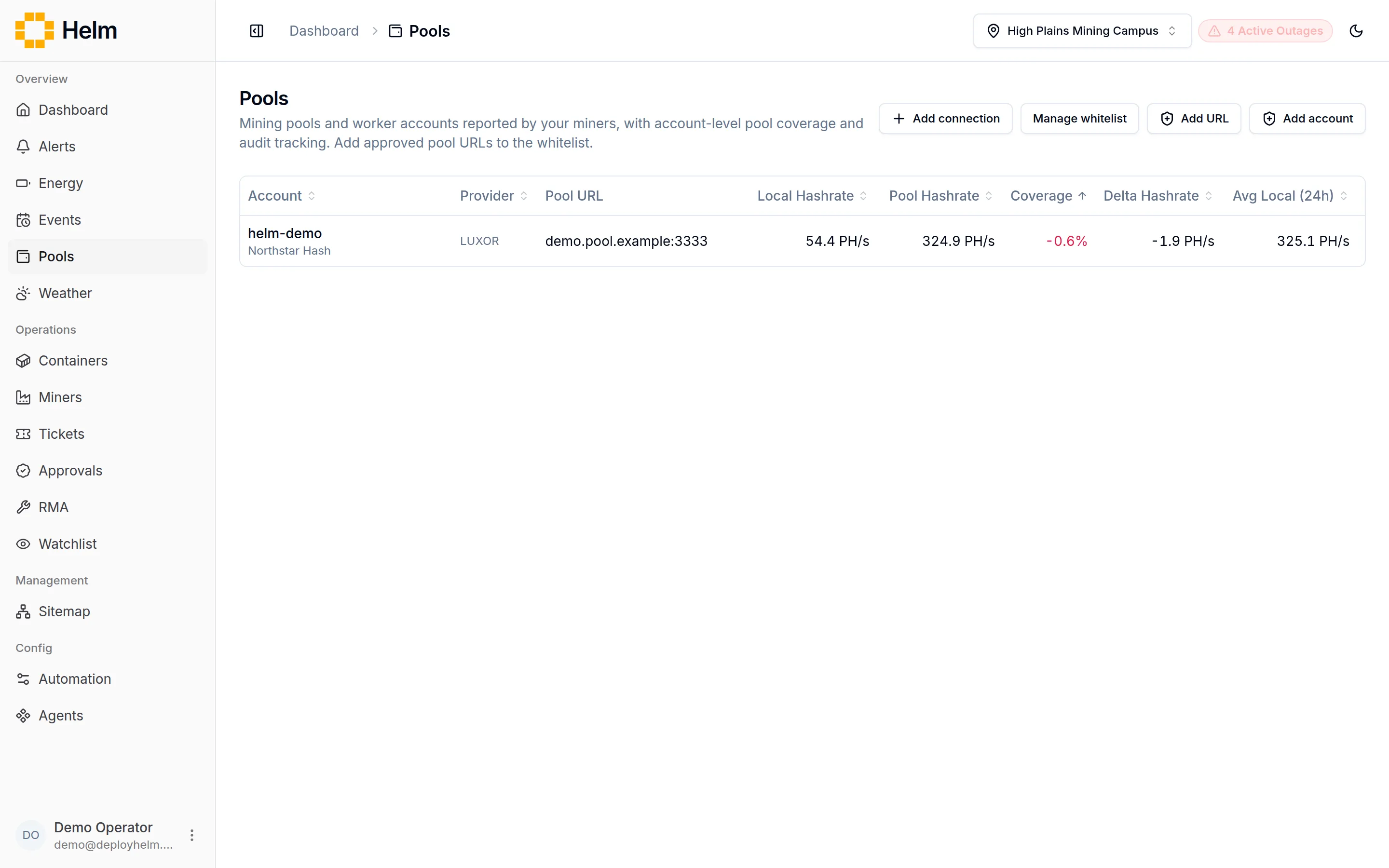
Captured from the Helm demo environment. Every number is simulated.
Report
The numbers leadership sees, on the floor
Operator and executive views read from the same KPI definitions. Managed operations clients see Managed Effective Hashrate (MEH), the ACS performance metric that measures only what operations controls.
- Live MEH dashboard for managed operations clients
- Weekly automated reports and shareable snapshots
- Self-service CSV/JSON export, any time, not just at contract end
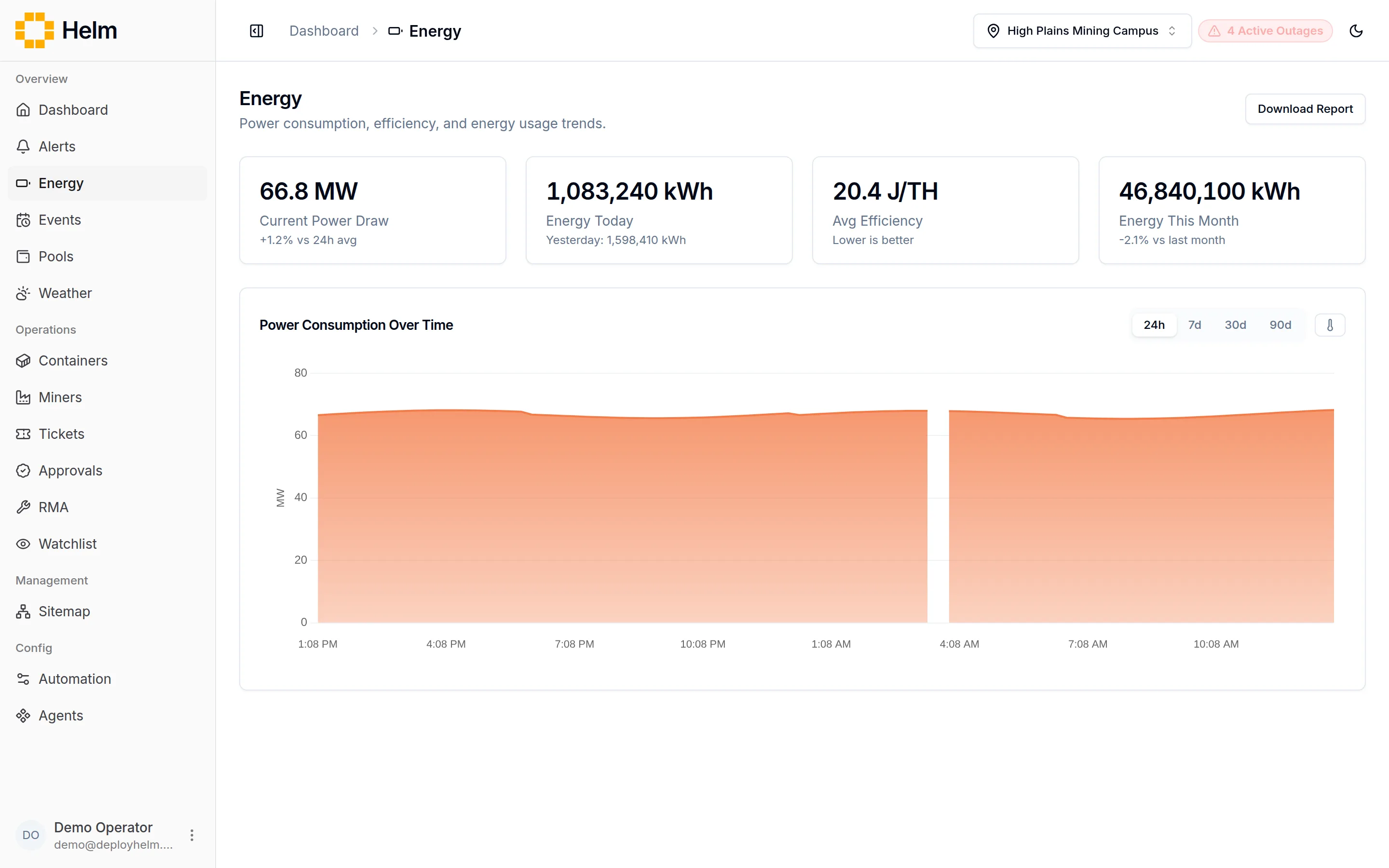
Captured from the Helm demo environment. Every number is simulated.
From signal to resolved, in one record
Most sites run monitoring, ticketing, and reporting in separate tools, and every handoff loses context. Helm keeps the whole loop in one place, from the first telemetry flag to the line on next week’s report.
Detect
Telemetry flags a unit drifting off its baseline, or a site-wide change in power or pool behavior.
Decide
Fault attribution and unit history show whether the cause is the hardware or the infrastructure around it.
Dispatch
The incident becomes a work order with an owner, whether that is a site technician or the ACS repair bench.
Report
The outcome lands in the same record leadership reads, so the next decision starts from real numbers.
Six modules, one platform
Monitor
Live fleet health across every site
- Hashrate, temperature, fan speed, and error codes per miner
- Per-site and fleet rollups
- Fast drill-down to weak units
Orchestrate
Coordinate miners, pools, and changes
- Config actions at fleet scale
- Pool routing with fallbacks
- Consistent runbooks per site
Optimize
Turn power into predictable uptime
- Power-aware operations
- Downtime-reduction loops
- Throughput against cost, in context
Forecast
Plan revenue and operating cost
- Production outlook
- Cost drivers in one model
- Side-by-side scenarios
Alert
Catch incidents before they spread
- Signal over noise
- Incident context attached
- Faster acknowledgement
Report
Report from a single source of truth
- Operator and executive views
- Consistent KPI definitions
- Shareable snapshots and CSV/JSON export
Works with how your sites already run
- Pool routing
- Fleet-wide pool changes, fallback routing, and an audit trail for every migration.
- Power and curtailment
- Demand-response events with production impact modeled before you commit.
- Multi-site command
- Health across every site, with playbooks that match how each one actually runs.
- Work orders
- Alerts become owned tasks, with context that follows the unit.
Connected to the repair floor
Helm is built by ACS, and it reads the same record our technicians write. When a unit leaves your site for repair, storage, or resale, its history goes with it.
Chain of custody
Serial and MAC scanned at removal and matched to Helm inventory before anything leaves the floor.
Condition reports
Per-unit inspection reports delivered in Helm, exportable as PDF or CSV.
Stored inventory
Units in ACS storage tracked by serial, model, condition grade, and location, with live counts.
Your data, portable
Telemetry, fault attribution, and outage logs export as CSV or JSON whenever you want them.
Free desktop utility
Helm Toolkit
ASIC discovery, bulk configuration, and LAN monitoring from your desktop. Free, no account, and it runs only on your local network.
Download the Toolkit(opens in a new tab)Runs on macOS, Windows, and Linux.
- Site and IP-range scanning
- Live fleet table with search and custom columns
- Pool presets with subaccounts and backups
- Batch power profiles, temperature limits, and firmware
- Reboot, blink LEDs, and pull logs, one unit or hundreds
- CSV export
Firmware families
- Stock Antminer
- LuxOS
- Whatsminer
- Braiins OS
- VNish
- Avalon
Implementation is part of the product
The Helm team scopes, installs, and trains with your operators. You do not get a login and a knowledge base. How long it takes depends on site access, inventory quality, and how many systems we connect.
Scope
We map your sites, pool contracts, and power reality before touching any config, and agree on what success looks like on day one.
Integrate
Our team handles the install and runs integration checks against your pools and infrastructure. Issues get flagged before the first shift.
Go live
Hands-on, shift-aware operator training, then close support after go-live. The first shift starts from the same numbers leadership sees.
Questions operators ask first
Who builds Helm?
ACS does. Helm is the operations platform behind ACS managed operations, built by the same company that repairs, stores, and resells mining hardware in Carrollton, Texas.
Do I need an ACS managed operations contract to use Helm?
No. Helm is available on its own. Every ACS managed operations client also gets Helm access, including the live MEH dashboard.
What does Helm cost?
Plans and pricing are on the Helm site. For a large or multi-site fleet, request a walkthrough and the Helm team will scope it with you.
Can I get my data out?
Yes. Telemetry, fault attribution, and outage logs export as CSV or JSON through self-service, whenever you want them.
Is the demo real data?
No. The demo is a simulated fleet. You can change settings, move miners, and try workflows freely, and it resets with your browser session.
How is the Toolkit different from Helm?
The Toolkit is a free desktop utility for discovering and configuring miners on one local network. Helm is the full platform: multi-site monitoring, alerts and work orders, pool and power operations, forecasting, and reporting.
See Helm on a fleet like yours
Walk the simulated fleet on your own, or book a walkthrough scoped to your sites, pools, and power.
See plans and pricing